A History Of The Racist Rebranding Of Watermelon In The US
A History Of The Racist Rebranding Of Watermelon In The US, And Why I Am Finally Ready To Reclaim My Slice
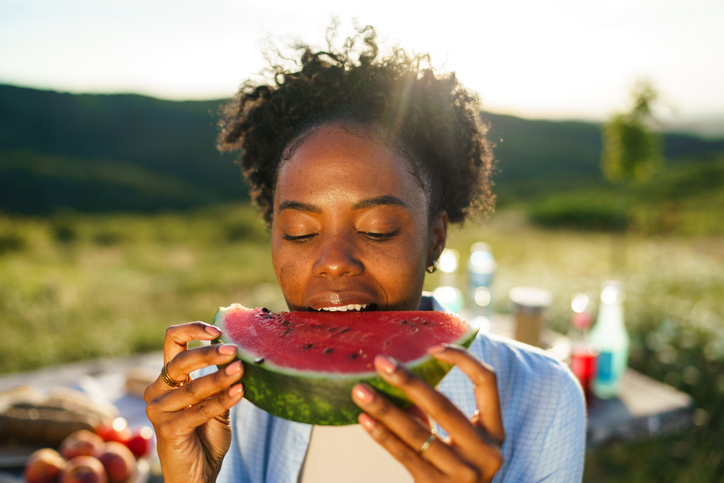
Happy Watermelon Month, everybody.
Dear reader, please feel free to roll your eyes right along with me.
Oh, watermelon. Ordinarily, this midsummer food and its holiday pass by without me paying it much, if any, attention.
As a kid, I wasn’t all that into watermelon. Cantaloupe, either. The ones I had access to on summer lunch trays and from the local grocery store didn’t vibe with my burgeoning palate.
Eating watermelon meant undertaking the cumbersome task of sifting through a mess of black seeds for flesh that lacked any real flavor. Cantaloupe was no better. I found it just as bland and watered down.
All of that changed when I was around 8 or 9 years old, living in Alexandria, Egypt, with my biological mother. The watermelon there tasted sweeter, denser, and far more flavorful. It became one of my go-to delicacies for beating the heat, and I couldn’t get enough melon or any of the other succulent fruit Egypt had to offer.
Looking back, it makes all the sense in the world that the best watermelon I ever had was in Egypt, on the same continent as its birthplace.
Genetic research from the University of Munich has even traced the origins of the modern sweet variety to an ancient tomb in Egypt, uncovered in 1876. Leaves of the fruit found inside the 3,500-year-old tomb proved that local farmers were cultivating the sweet, red fruit we love today.
DNA tests showed that this Egyptian variety of watermelon had its roots in a watermelon variety grown in Sudan. From there, researchers have traced the watermelon’s ancestry to the Kordofan melon, a wild, sweet, white-fleshed fruit believed to have been first domesticated in Sudan before making its way up the Nile into Egypt.
Watermelon came to the United States via the transatlantic slave trade. Watermelon seeds were among the provisions carried on slave ships alongside crops like okra, sorghum, and black-eyed peas. Enslaved people kept garden plots on plantation land where they grew food like watermelon for themselves.
After emancipation, formerly enslaved people across the South began growing watermelon on their own land and selling it as a cash crop. The fruit was relatively cheap to grow and required little land or capital, which made it accessible to people who had just been declared free. Freed people used the fruit to enact and celebrate their new property rights, growing it, eating it, and selling it in the public square.
After the Civil War, Black farmers became the nation’s largest producers of watermelon, and the fruit became a means of building income and property ownership outside a plantation system designed to keep them landless. This also made it one of the first tangible paths to Black economic independence during Reconstruction.
After my mother and I settled back into the United States, I quickly lost my newfound interest in watermelon and cantaloupe. All it took was one bite of cantaloupe added to my lunch tray, and I was reminded why I didn’t like it. Nothing about the melons from local markets carried the vitality of taste I remembered from those available in Alexandria.
What further moved me away from the fruit was hearing kids telling jokes on the playground about Black people eating fried chicken and watermelon. That planted in me the understanding that liking either one, as a Black person, would confirm I was lazy and dirty by default. It made little sense then to keep eating a fruit that barely tasted like anything, just to hand someone the satisfaction of watching me confirm for them a persistent stereotype they held about Black people. In my mind, avoiding the fruit felt like I was taking power away from the stereotype.
In reality, I was placing a restriction on myself and, in a way, bending to the very thing I thought I was resisting.
What I didn’t know as a child huddled on that playground was that my impulse to avoid eating watermelon in mixed company had been carefully engineered generations before I was born.
Watermelon jokes are leftover remnants of a post-Civil War smear campaign designed to turn what had been a tool of self-reliance for Black people into a badge of laziness. The economic progress that watermelon paved the way for threatened the existing social and economic structures of that time. In response, critics weaponized the fruit through popular culture, print ads, and minstrel shows. They intentionally sought to create a narrative through imagery that Black people were unrefined, easily satisfied, lazy, and distracted by a piece of fruit.
The campaign gaslit the public by actively rebranding the watermelon, twisting a vivid sign of liberation into a manufactured symbol of laziness. By mocking the fruit, the original campaign removed economic progress entirely from the equation, creating a narrative that was easier to spread and harder to refute than a direct political argument for systemic oppression and inequality.
From a psychological standpoint, this caricature worked because it replaced a complex person with a simple, fixed image with the aim of permanently linking watermelon to Black people. Once that image was repeated enough, people stopped questioning it and instead reacted to the stereotype, rather than considering the multifaceted humanity standing before them.
The lasting legacy of this caricature is a persistent attempt to take away the simple right to look at that fruit with pride, denying us the enjoyment of something our ancestors cultivated to build economic freedom.
The stereotype has revealed itself to be so persistent that it was wielded on more than one occasion during the tenure of our first Black president, Barack Obama. In 2009, less than two months into former President Obama’s first term in office, the mayor of Los Alamitos, California, sent an email depicting the White House lawn containing watermelons instead of Easter eggs. Then, during his second term, the Boston Herald ran a cartoon of an intruder sitting in Obama’s bathtub asking if he had tried the “new watermelon-flavored toothpaste.”
When I told my OG, who is my adopted mother, that I was writing this piece tied to National Watermelon Month, true to her nature, she offered a brief, knowing summation of the history lesson and headed straight to the wellness case.
Her perspective is grounded in the functional value of what we put into our bodies. Watermelon is mostly water, which gives our bodies an incredibly efficient way to hydrate while delivering important nutrients. It contains high levels of an amino acid called citrulline, which helps relax blood vessels, supporting healthy circulation and blood pressure. The fruit is also rich in lycopene, an antioxidant found in tomatoes, which supports heart health.
By the way, my OG did not need a peer-reviewed health or nutrition study for any of this. She knows that what feeds and nourishes a body stems from nutritional value, something with deeper origins than the propaganda and racist trap created to try to shame us out of unabashedly enjoying a tasty summer delicacy.
So with all of that in mind, this summer I’ve decided to make it my goal to locate some watermelon that most closely matches the sweet and juicy variety of the watermelon I ate as a kid on the streets of Alexandria. Once I find it, I intend to enjoy every single bite with absolute pride, honoring the autonomy our ancestors cultivated, completely free from the burden of caring about who might be watching.
SEE ALSO:
How the WNBA’s Leadership Problem Has Become Impossible To Ignore
In A World Full Of Targets, The WNBA Needs To Be A Costco
A History Of The Racist Rebranding Of Watermelon In The US, And Why I Am Finally Ready To Reclaim My Slice was originally published on newsone.com