Timeline: The History Of The Montgomery Bus Boycott - Page 4
- 1946: Women's Political Council begins work to dismantle bus segregation.
- Dec 1, 1955: Rosa Parks' arrest sparks the Montgomery Bus Boycott.
- Dec 20, 1956: Boycott ends after Supreme Court rules bus segregation unconstitutional.

December 5, 1955, marks the anniversary of the Montgomery Bus Boycott, one of the most pivotal moments in the American civil rights movement. It demonstrated how collective action, strategic planning, and unwavering courage can transform a nation. What began as a local protest against racial injustice soon evolved into a 13-month struggle that gained international attention, propelled new leaders into the national spotlight, and established nonviolent mass protest as a defining tool in the fight for equality. The following timeline traces the key events that shaped the boycott from its earliest roots to its lasting legacy.
RELATED: The Real Story Behind Rosa Parks’ Bus Ride And What’s Often Overlooked
1946 – The Women’s Political Council begins work to dismantle segregation on buses.
According to Stanford University, the groundwork for the Montgomery Bus Boycott started long before Rosa Parks refused to give up her seat. In 1946, the Women’s Political Council (WPC), a group of Black professionals, began focusing on discrimination on Montgomery’s bus system. Their activism intensified by March 1954, when members met with Mayor W. A. Gayle and demanded changes such as an end to forcing Black riders to stand over empty seats, the elimination of the practice requiring them to pay at the front and re-enter from the rear, and equal stopping patterns in Black neighborhoods. When no changes followed, WPC president Jo Ann Robinson restated these concerns in a letter sent on May 21, 1954, warning, “There has been talk from twenty-five or more local organizations of planning a city-wide boycott of buses.”
March 1955 – The arrests of Claudette Colvin and Mary Louise Smith.
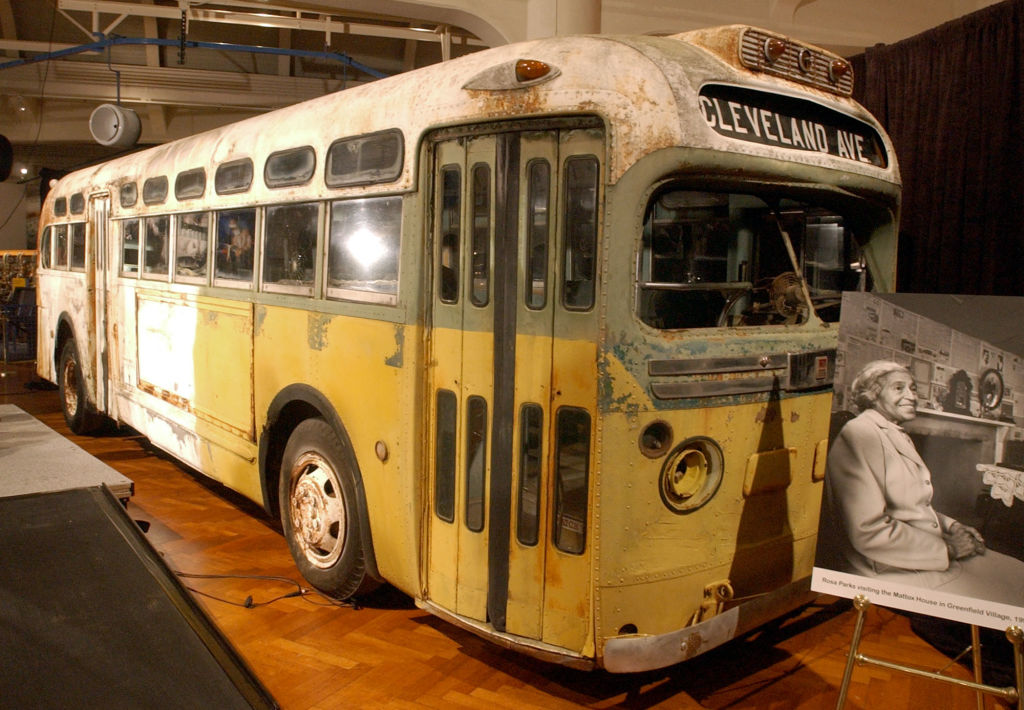
The following year, on March 2, 1955, 15-year-old Claudette Colvin was arrested for refusing to surrender her seat on a bus, drawing on what she’d learned about the Constitution and racial injustice. When a white woman refused to sit beside her, and the driver demanded she move, Colvin stayed seated, later saying, “I knew I had rights.”
After a tense confrontation witnessed by classmates, police dragged her off the bus, taunted her, and arrested her. But her bravery energized local activists, including Rosa Parks, Virginia Durr, Jo Ann Robinson, E.D. Nixon, and Martin Luther King Jr., who pushed for change despite being ignored by city officials. Although community leaders initially considered using Colvin’s case to challenge segregation, her conviction for assaulting officers prevented an appeal. Still, her arrest played a crucial role in the growing movement, and Parks later highlighted Colvin’s importance in the fight for desegregation.
Seven months later, Mary Louise Smith, age 18, was also arrested for the same act of defiance. Although both incidents challenged the city’s segregation laws, neither arrest mobilized the community as extensively as the events that followed.
Dec. 1, 1955 – Rosa Parks’ arrest sparks the Montgomery Bus Boycott.

Everything changed on Dec. 1, 1955, when Rosa Parks refused to give up her seat in the middle section of a Montgomery bus, an area where Black riders could sit but could be forced to move “on the whim of the bus driver.” When a white man boarded, and no seats remained, the driver, James Blake, demanded that Parks and several others give up their seats, warning, “You all better make it light on yourselves and give me those seats.” While the others complied, Parks refused, thinking of her grandfather and Emmett Till, believing that giving up her seat “wasn’t making it light on ourselves as a people.”
Reflecting on her decision later, she said, “I felt that if I did stand up, it meant that I approved of the way I was being treated, and I did not approve.” Police arrested her, and E. D. Nixon, assisted by Virginia and Clifford Durr, secured her bail. Her prior activism and her deepening involvement with the WPC helped thrust her arrest into the center of the civil rights struggle.
Dec. 5, 1955 – The Montgomery Bus Boycott begins.
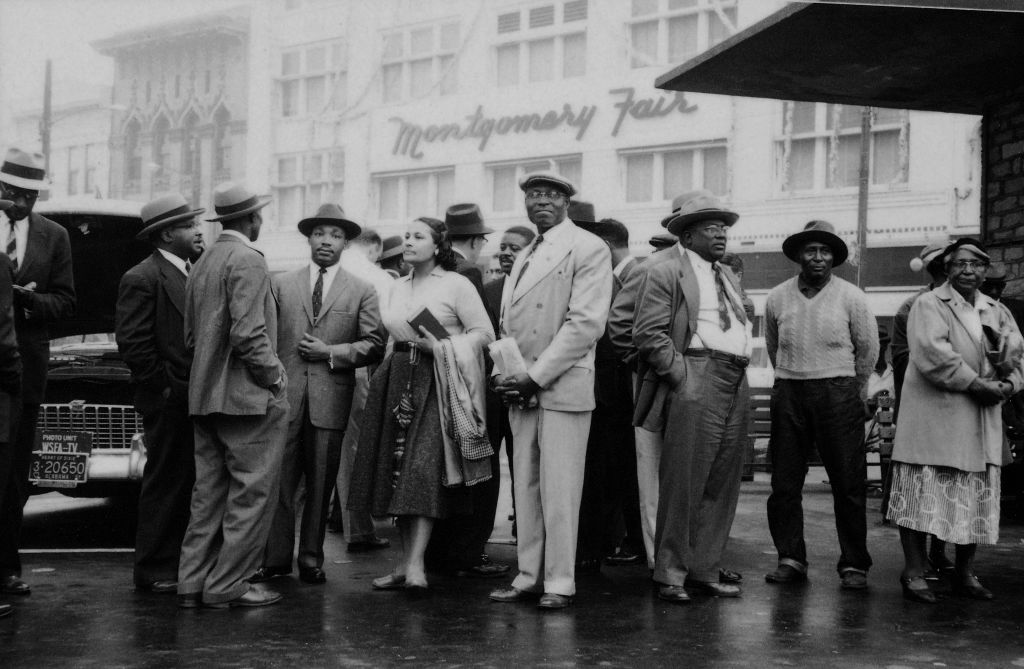
On Dec. 2, the city’s Black ministers and leaders, including Ralph Abernathy and Martin Luther King Jr., met at Dexter Avenue Baptist Church and agreed to promote a one-day boycott of city buses scheduled for Dec. 5. The protest gained unexpected publicity through radio, television, and newspapers. When that day arrived, approximately 90 percent of Montgomery’s Black riders stayed off the buses. That afternoon, community leaders discussed extending the protest and founded the Montgomery Improvement Association (MIA), electing King as its president.
At a mass meeting that evening at Holt Street Baptist Church, thousands gathered as the MIA voted to continue the boycott. King addressed the crowd with a speech that resonated throughout the movement, declaring:
“I want it to be known that we’re going to work with grim and bold determination to gain justice on the buses in this city. And we are not wrong.… If we are wrong, the Supreme Court of this nation is wrong. If we are wrong, the Constitution of the United States is wrong. If we are wrong, God Almighty is wrong.”
Dec. 8, 1955 – The MIA doubled down on its demands, extending the boycott.
Negotiations with city leaders and the bus company failed, leading the MIA on Dec. 8, 1955, to formally demand courteous treatment by bus operators, first-come-first-served seating, and the hiring of Black drivers on primarily Black routes. This pushed the boycott into a 381-day mass protest.
The Montgomery Bus Boycott ran from Dec. 5, 1955, to Dec. 20, 1956. During that time, city authorities penalized Black taxi drivers who supported the movement by driving Black riders around the city. The MIA created a large-scale, 300-car carpool system modeled after one used in Baton Rouge in 1953, to help those participating in the boycott. WPC members also took on critical roles in organizing meetings, running carpools, and sustaining the daily coordination needed to maintain the boycott.
Feb. 1956 – A federal district court rules that bus segregation is unconstitutional.
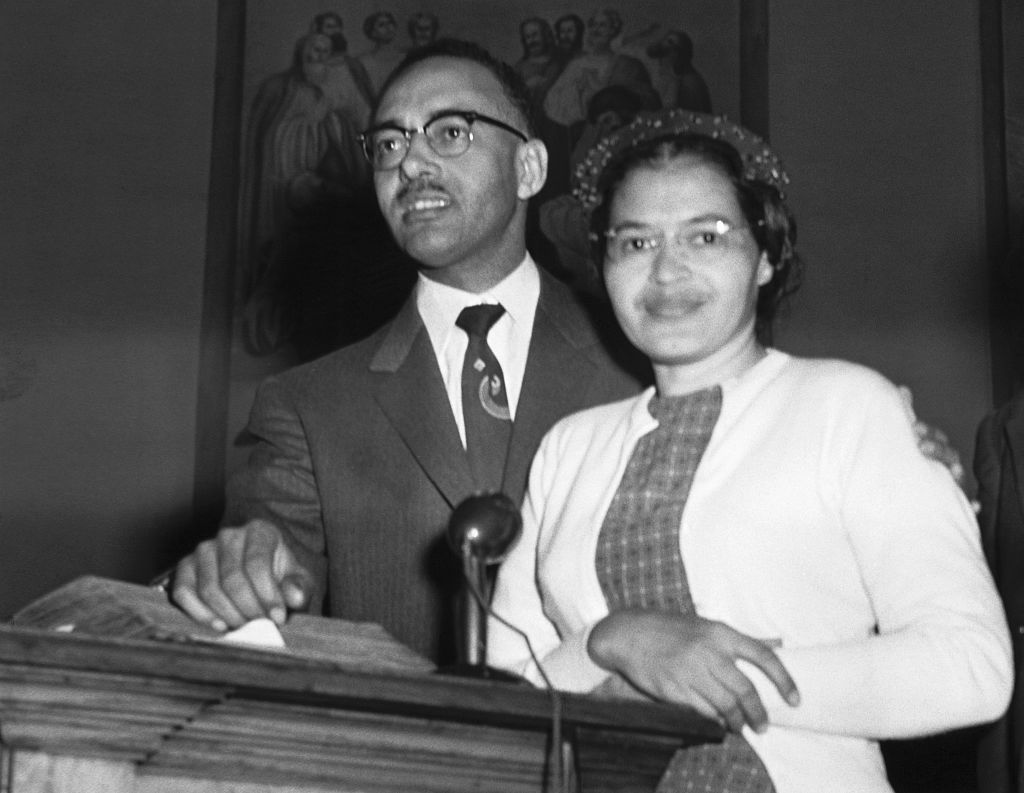
By February 1956, the city sought injunctions to stop the boycott and indicted over 80 leaders—including King—under a 1921 anti-conspiracy law. King was convicted in the case State of Alabama v. M. L. King, Jr., and fined $500 or sentenced to 386 days in jail. Nonetheless, the movement continued.
A breakthrough came on June 5, 1956, when a federal district court ruled in Browder v. Gayle that bus segregation was unconstitutional. The ruling was appealed, and in November 1956, the U.S. Supreme Court affirmed the decision, striking down all bus segregation laws. The same day the ruling was affirmed, King and the MIA were in circuit court contesting injunctions against the carpools. Determined to continue the protest until the official mandate arrived, the MIA operated without the carpool for an additional month.
Dec. 20, 1956 – The Montgomery Bus Boycott officially ends.

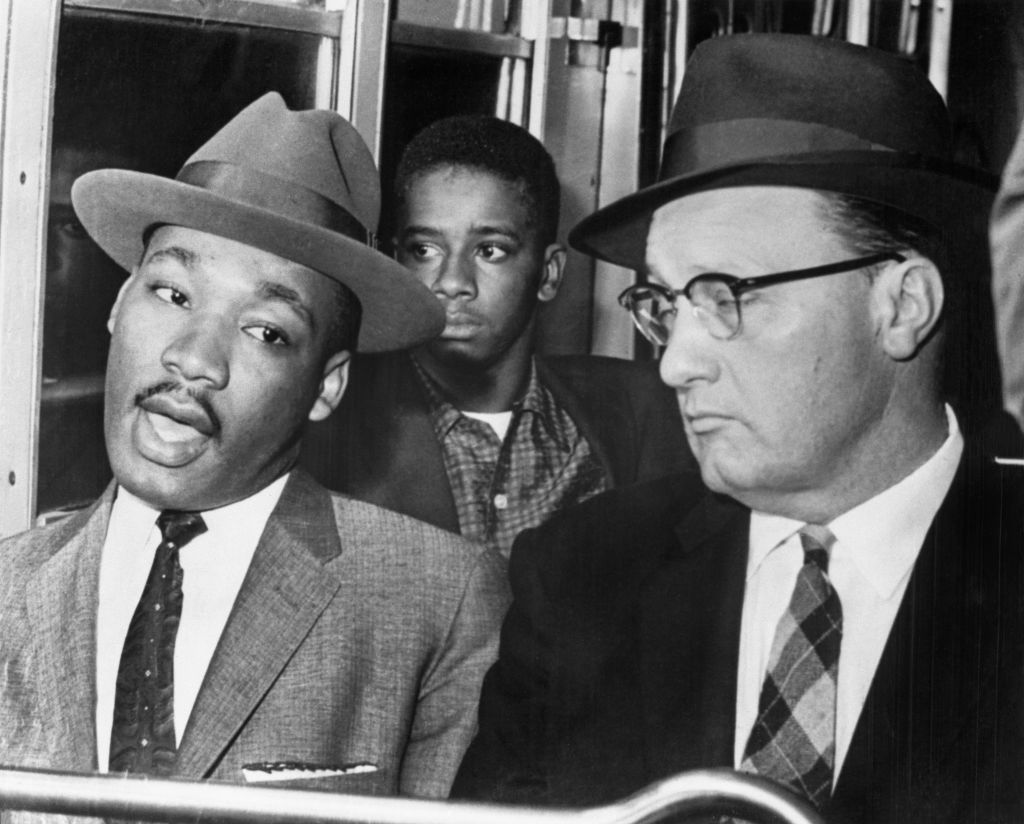
On Dec. 20, 1956, the Supreme Court’s order finally reached Montgomery. King announced the end of the boycott, and the community agreed. The next morning, on December 21, 1956, King boarded an integrated bus alongside Ralph Abernathy, E. D. Nixon, and Glenn Smiley. Reflecting on the movement, King said, “We came to see that, in the long run, it is more honorable to walk in dignity than ride in humiliation. So … we decided to substitute tired feet for tired souls, and walk the streets of Montgomery.”
The boycott marked a turning point in U.S. history and demonstrated how sustained, nonviolent protest could dismantle entrenched systems of segregation.
SEE MORE:
Timeline: The History Of The Montgomery Bus Boycott - Page 4 was originally published on newsone.com